

Material reference properties
These material reference values are not tied to a specific grade, batch or test method. Confirm the supply specification for each grade.
Swipe to compare all columns ↔
| Property | Reference | Unit | Note |
|---|---|---|---|
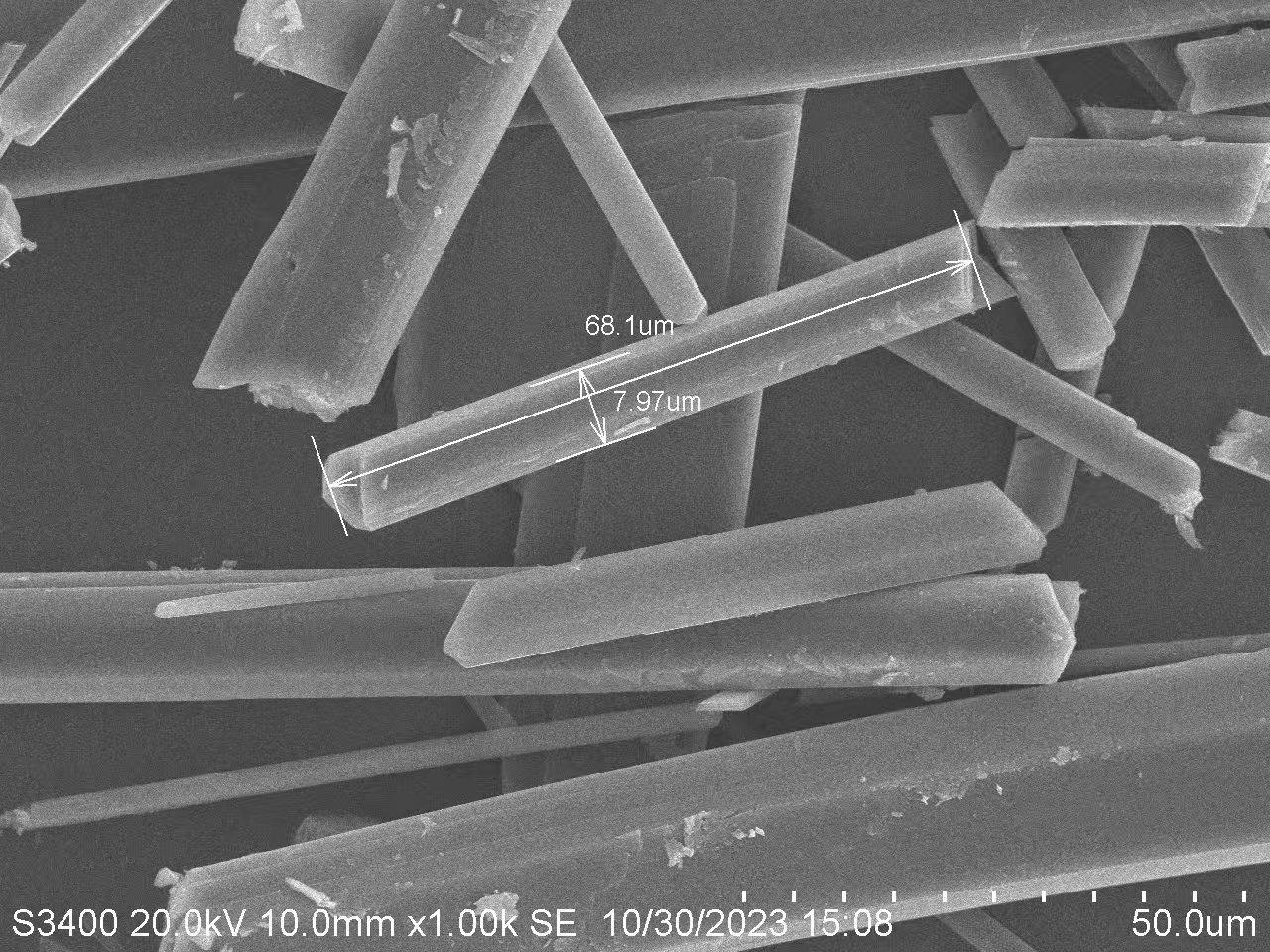
| Average diameter | 1–8 | μm | Another source states 1–10; confirm grade |
| Average length | 30–200 | μm | Another source states 20–100; do not combine into a guaranteed range |
| Aspect ratio | 10–200 | — | Stated reference range, not a guarantee for each whisker |
| Whiteness | ≥98 | % | Another source states ≥96; method not specified |
| Calcium sulfate content | ≥98 | % | Does not support a universal 99.8% claim |
| Density | 2.69 | g/cm³ | Reference value; method not specified |
| Loose bulk density | 0.1–0.4 | g/cm³ | Another source states 0.3–0.5; differs from true density |
| Refractive index | 1.585 | — | Wavelength and temperature not specified |
| Tensile strength | 20.5 | GPa | Whisker-level claim without method; not a composite-part strength |
| Tensile modulus | 178 | GPa | Whisker-level claim; method and sample require verification |
Using the data for selection
First confirm crystal form and process window, then grade morphology, moisture and surface treatment. Compare tensile, flexural, impact, flow, appearance and unit cost in your matrix. The stated melting point of approximately 1450°C is not a composite service-temperature rating.